
April 16, 2026 • By Eden Health Alaska Team
Aging with Strength and Vitality Seminar
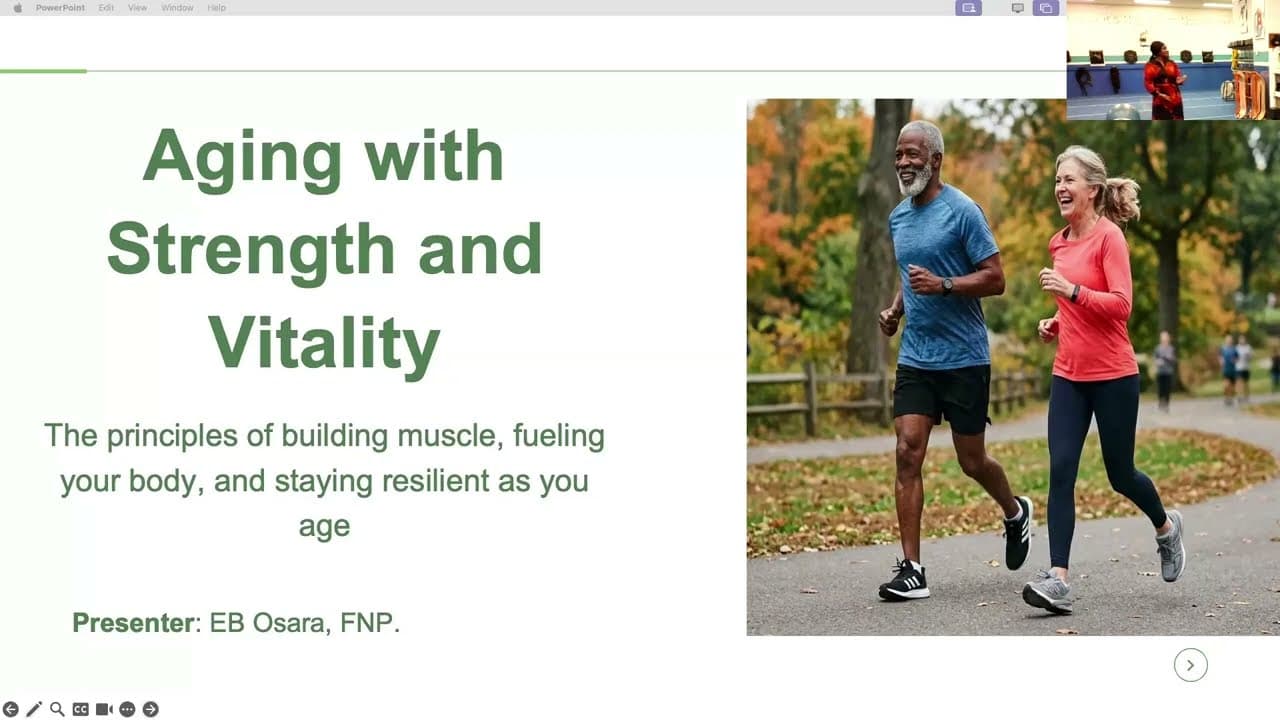
Watch our full seminar on how to maintain your health, energy, and strength as you age with integrative medicine and lifestyle changes.
Join us for the Aging with Strength and Vitality Seminar to learn how to maintain your health, energy, and strength as you age. In this deep dive, we explore the core tenets of integrated health and actionable steps you can take today to improve your longevity.
Aging With Strength and Vitality: The Principles of Building Muscle, Fueling Your Body, and Staying Resilient as You Age
By EB Osara, FNP | Eden Health Alaska
What if the biggest gap in modern healthcare isn't a lack of medication — it's a lack of prevention? After years working in acute care, watching the same patients cycle through the same revolving door with the same chronic conditions, I became convinced there had to be a better way. That conviction is what led me to integrative health, and ultimately to the topic I want to explore with you today.
This isn't just a conversation for people in their 60s or 70s. If you're in your 30s or 40s, this is especially for you — because the decisions you make now will determine what your body is capable of decades from now.
The Problem With "Normal"
Here's something the conventional medical system rarely tells you: normal is not the same as optimal.
The reference ranges on your lab results were largely derived from population studies that included people who were stressed, inflamed, and metabolically compromised. Being told your numbers are "normal" doesn't mean your body is functioning at its best — it means you're average. And average, in today's chronically overworked, under-slept, processed-food-eating society, isn't a high bar.
I'd also encourage you to think about trending your labs, not just looking at a single snapshot. If your A1C was 5.3 three years ago and it's 5.6 today, that's still technically normal — but the direction matters. Your body doesn't become pre-diabetic overnight. It sends signals for years before a diagnosis arrives. Catching and responding to those trends is where real prevention happens.
What Actually Drives Aging?
Before we talk solutions, let's talk about what's working against us. There are several key drivers of aging that I see time and again in my practice:
Chronic inflammation is perhaps the most pervasive. Unlike the acute inflammation that helps you heal a paper cut, chronic low-grade inflammation — driven by constant stress, poor sleep, processed food, and gut imbalance — quietly damages blood vessels, accelerates brain aging, and sets the stage for insulin resistance.
Speaking of which: insulin resistance is one of the most important — and most underdiagnosed — metabolic conditions of our time. Every time we eat, our pancreas releases insulin to help our cells use that food as fuel. But when we're constantly grazing (hello, office candy bowl), our cells eventually become deaf to insulin's signal. Instead of fuel, we get excess blood sugar, excess stored fat, and a cascade of downstream health problems. And one of the biggest consequences of insulin resistance is the accumulation of visceral fat — the fat stored around your organs — which significantly raises cancer risk.
Mitochondrial decline is another factor. Your mitochondria are your cells' power plants. As they decline with age, you get fatigue, brain fog, and slower recovery from exercise. That feeling of "I just don't bounce back the way I used to" is real, and it has a biological explanation.
Muscle loss is perhaps the most overlooked driver of metabolic disease and falls in aging. I'll go into more depth on this below, because it's that important.
Hormonal shifts affect both men and women starting in their 40s. Declining testosterone, estrogen, and progesterone don't just affect reproduction — they affect your muscles, your brain, your sleep, your mood, and your metabolism. I've seen many women get prescribed antidepressants in perimenopause when what they actually needed was progesterone support. I've seen men frustrated that the workouts that kept them lean at 35 aren't working at 45. Hormones are a piece of the puzzle worth taking seriously.
Finally, chronic stress ties everything together. When cortisol is chronically elevated, insulin goes up, cells become insulin resistant, inflammation rises, and the whole system suffers. Stress isn't just a mental health concern — it's a metabolic one.
Why Muscle Is Your Most Underrated Health Asset
I want to spend some time on muscle, because most people drastically underestimate its role in long-term health.
Your muscles are your body's primary reservoir for glucose. When you eat carbohydrates, insulin signals your muscle cells to absorb and store that glucose. The more muscle you have, the more storage capacity you have, and the better your blood sugar stays regulated. This is one of the reasons type 2 diabetes has historically been associated with aging — as we lose muscle, we lose that glucose reservoir.
Muscle also helps regulate hormones, reduce inflammation, and improve your body's response to stress. And of course, maintaining muscle is directly tied to your ability to stay balanced, mobile, and independent as you age.
So what does muscle need to thrive? Two things above all else: resistance training and adequate protein.
Running, walking, and cycling are wonderful for cardiovascular health — but they don't builds significant muscle. If you want to preserve and build muscle as you age, you need to lift weights or do some form of resistance training. I often tell patients that I wish I had a prescription pad for exercise, because that's truly what it is — medicine.
On protein: aim to eat it with intention, especially if you're over 40. Protein is the literal building block of muscle tissue. If you're not sure how much you need, work with a provider who can calculate it based on your body composition and health history. (Note: those with kidney disease should get individualized guidance before increasing protein intake.)
A Word on Hormones
Hormone replacement therapy has become a hot topic, and for good reason. For women navigating perimenopause and beyond, restoring estrogen, progesterone, and testosterone can be genuinely life-changing.
Estrogen protects cognitive function and memory, supports muscle preservation, helps regulate metabolism, and plays a key role in gut health. Progesterone supports sleep and has a calming, anti-anxiety effect via its interaction with GABA receptors. Testosterone — yes, women need it too — supports muscle, energy, and mood.
One important caveat: you cannot put hormones into a chronically inflamed, highly stressed body and expect results. If the underlying environment isn't addressed first, hormone therapy won't work as intended. This is why comprehensive lab work matters so much before starting any hormonal intervention.
There is also no age cutoff for hormone therapy. Provided there are no contraindications, it can be beneficial at any stage of life.
The Sleep Factor
I'll give you a real example of why sleep matters more than most people realize. I had a patient — athletic, active, eating well — who came in with pre-diabetic numbers. The culprit? He was sleeping four hours a night.
Sleep is when your body repairs muscle, regulates cortisol, consolidates memory, and resets insulin sensitivity. Skimp on sleep and you undermine nearly every other health effort you're making. If you're exercising and eating well but not sleeping, you're building on a shaky foundation.
Practical Starting Points
You don't need to overhaul your entire life at once. Sustainable change comes from changing one small thing at a time.
- Start moving. If you've never exercised regularly, begin with 15 minutes of walking after each meal. That's 45 minutes of daily movement before you've set foot in a gym.
- Add resistance training. Aim to lift weights or do bodyweight exercises at least 2–3 times per week.
- Prioritize protein. Make sure it's present at every meal.
- Eat real food. If you can't recognize most of the ingredients on a label, your body probably can't either.
- Choose unrefined carbohydrates. Whole grains, legumes, and vegetables contain fiber that slows glucose absorption and feeds your gut microbiome. Refined carbs are what drive blood sugar spikes and insulin resistance.
- Get your labs done — and trend them. Not just the basics your insurance covers, but a comprehensive panel that includes hormones, micronutrients, inflammatory markers, and metabolic indicators. Then check them again in a year, and the year after that.
- Know your body composition. The scale doesn't tell you whether you're gaining muscle or losing it. Body composition analysis does.
- Sleep like it's medicine. It is.
- Take targeted supplements. Not 40 different things, but what your labs actually show you need. And make sure your gut is absorbing them — if it's not, no amount of supplementation will help.
One Final Thought: Healthspan vs. Lifespan
We're pretty good at talking about lifespan — how long we want to live. But we rarely ask the more important question: what do we want our health to look like for all those years?
That's healthspan. And it's shaped by physical health, cognitive health, emotional wellbeing, and the ability to do the things that matter to you — hiking, traveling, lifting grandchildren, enjoying retirement without spending every dollar managing chronic disease.
The body you'll inhabit at 70 or 80 is being built right now, with every night of sleep, every workout, every meal, every decision to manage stress rather than ignore it. It's not too late to start — at any age. But the earlier you begin, the more you have to work with.
I hope this gives you a framework and a starting point. If you want to dig deeper, you know where to find me.
EB Osara is a family nurse practitioner and the founder of Eden Health Alaska, an integrative health practice focused on prevention, lifestyle optimization, and comprehensive lab-based care.